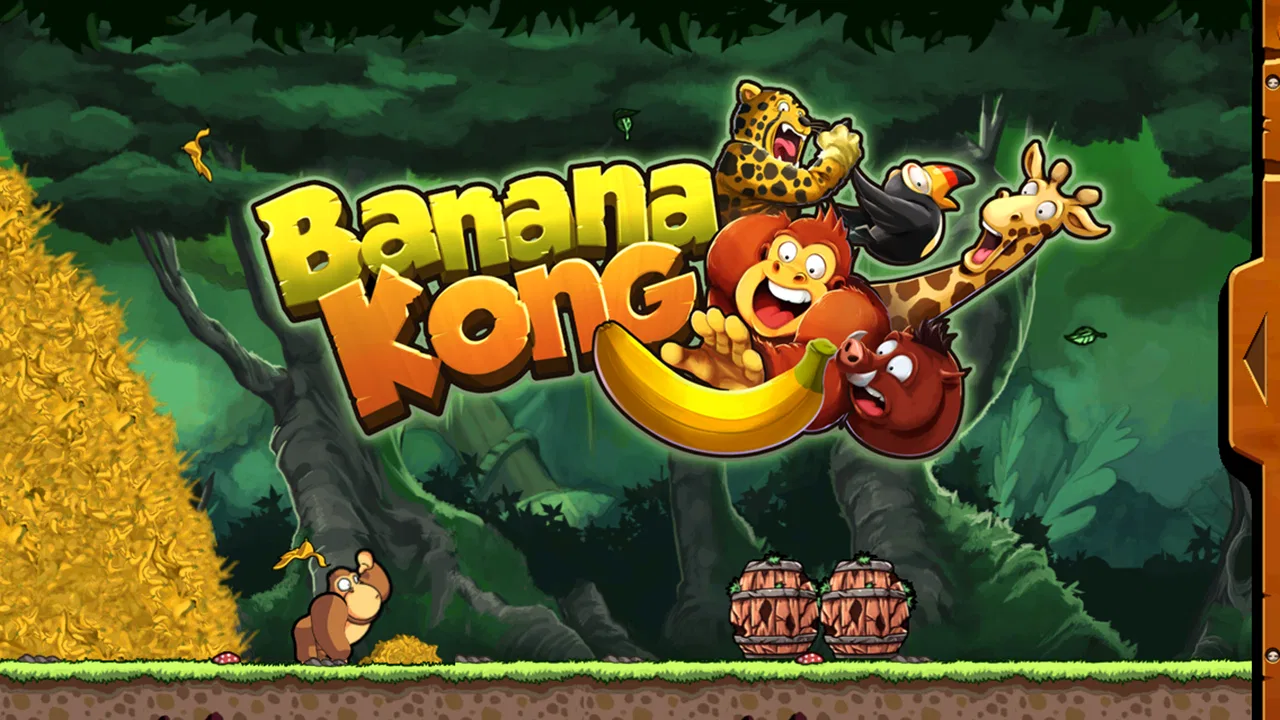
Banana Kong
- 4.7
- Rating
- 100.00M
- Installs
- Free
- Price

 Analysis by App-foxy
Some endless runners feel like disposable reflex tests, but Banana Kong has a more playful rhythm that kept me coming back. I guide a fast-moving gorilla through changing jungle scenery, reacting to gaps, obstacles, slopes, and whatever appears in the next stretch of the path. It is easy to understand within seconds, yet the speed and layout changes give each run enough tension to make “one more try” feel natural.
This is a free action game from FDG Entertainment GmbH & Co.KG, suitable for Everyone and available on devices running Android 8.0 or later. Its 4.7 average from around 5.1 million ratings, together with over 100 million installs, suggests that it has reached far beyond the usual audience for small arcade games. After spending time with it, I can see why: the controls are approachable, the runs are short enough for everyday use, and the jungle setting gives the familiar runner format a distinct personality.
How the current version feels in everyday play
The central idea is wonderfully direct. The character keeps moving, while I control the actions needed to stay alive and collect useful items. I do not need a long tutorial or a complicated menu system before playing. That simplicity makes it a good choice when I have only a few minutes, such as while waiting for an appointment or taking a short break between tasks.
You May Also Like

 Pandora - Music & Podcasts
Pandora’s Music Is Easy to Start, but Harder to Recover
Pandora’s strength is its low-effort path from a seed to a station. Its weak spot is how much confidence it asks you to place in connection, setup, and quiet recovery.

 AccuWeather: Weather Radar
AccuWeather Review: A Quick, Clear Forecast for Everyday Decisions
For everyday plans, the best forecast is the one you can understand quickly. AccuWeather makes rain timing, radar, and local conditions easy to act on, with a few trade-offs.

 Hill Climb Racing
Why Hill Climb Racing Still Turns Crashes Into One More Run
A tiny car, a bumpy hill and one more upgrade: Hill Climb Racing keeps resurfacing because its simple chaos makes every near-miss feel personal.

 AliExpress - Shopping App
AliExpress Makes Global Shopping Feel Personal, but Shoppers Bear the Risk
AliExpress turns a global marketplace into a pocket-sized discovery engine. Its reach is useful, its shopping loop compelling, and its trade-offs easy to miss.

 Lords Mobile: Kingdom Wars
Lords Mobile Is a Kingdom-Building Routine, Not a Quick Match
A case-by-case verdict on the building, battles, device demands, and social commitments that make Lords Mobile rewarding for some players and exhausting for others.

 PDF Scanner app - TapScanner
TapScanner Makes Paperwork Easier to Capture, Check, and Share
TapScanner makes scanning with a phone feel less like a rescue operation and more like a dependable step in getting work done. Its capture tools are useful, though not flawless.
More From Our News Desk
View All News


What makes the game more interesting than a basic left-and-right dodging exercise is the way the environment changes the feel of movement. Jungle paths, caves, and treetop sections do not simply provide different wallpaper. They alter how I read the screen and how quickly I decide whether to jump, drop, or keep moving. A safe-looking route can become dangerous when the next obstacle arrives before I have fully recovered from the previous one.
I found the best runs came from looking slightly ahead rather than staring at the character. That habit matters because the game rewards anticipation more than frantic tapping. When I focus only on the gorilla, I react too late. When I scan the upcoming terrain, I can prepare a movement and avoid wasting a run on an obstacle that was visible several moments earlier.
The controls are particularly well suited to touchscreens. They do not ask me to manage a virtual joystick or several small buttons at once. That leaves more of the screen available for the action and makes the game comfortable on both compact phones and larger displays. The trade-off is that a simple control scheme gives me less room to correct a mistake once the pace becomes intense. The game is easy to start, but dependable precision still takes practice.
Why short sessions work so well
One of the strongest practical qualities is how naturally the game fits into fragmented time. A run can begin immediately, and failure does not require a long recovery sequence before I can try again. I can play casually while waiting for a download, or I can focus for longer when I want to improve a previous attempt. That flexibility is more useful than it sounds because many action games either demand a substantial time commitment or interrupt the flow with too many menus.
I also like that the game creates a clear personal challenge without requiring a formal competitive setting. My goal may be to survive longer, collect more bananas, or simply get through a section that ended my previous attempt. This makes it suitable for players who enjoy improving their own timing but do not want a story-heavy campaign or a demanding multiplayer schedule.
For a realistic everyday example, I would recommend it to someone commuting by bus who wants an offline-style arcade experience that can be picked up and put down quickly. I would not choose it for a quiet activity during a meeting or a situation where sudden sound and fast reactions would be inconvenient. Its compact format is convenient, but the later intensity still asks for attention.
Movement, terrain, and the value of observation
The jungle theme does more than make the screen colorful. It gives the game a readable visual language: open stretches invite confidence, enclosed areas make me cautious, and elevated routes encourage me to judge distance before committing. I learned to treat every new environment as a small change in the rules of perception. The same reflex that works in an open section may not be enough when the view becomes busier.
A useful technique is to avoid making every movement at the last possible moment. Early, controlled actions are usually easier to understand than desperate corrections. I also found it helpful to recognize when collecting an item was not worth the risk. The temptation to chase every banana can push the character into an awkward position, especially when the safest route is slightly less rewarding.
That trade-off gives the game more depth than its cheerful presentation suggests. I am not only asking, “Can I reach that item?” I am also asking, “Will taking it leave me prepared for what comes next?” This is one of the more rewarding lessons in the game, and it is something a generic description would not tell a new player.
How the game has evolved without losing its identity
The current version is listed as 1.9.17.03, while the game first appeared on December 3, 2013. That long span matters because the experience still feels built around a clear arcade foundation rather than a constantly changing service model. The basic appeal remains immediate movement, quick decisions, and repeat attempts, which helps the game feel coherent for people discovering it now as well as for returning players.
For existing players, the most important point is continuity. Someone who enjoyed the game earlier should not need to relearn an entirely different format just to understand a current run. The familiar structure remains the reason to return, while the variety of terrain keeps the action from becoming a single repeated visual pattern. I see that as a sensible form of evolution: the game can remain recognizable without becoming stale after a few sessions.
At the same time, players should set realistic expectations about what this kind of update path means. This is still an arcade runner, not a large role-playing game with a constantly expanding campaign. The version number indicates a maintained product, but it does not turn the experience into something designed around deep narrative progression or complex strategy. If you want a game that changes dramatically from month to month, another category may suit you better.
Free access and the role of purchases
The game is free to download, with optional in-app purchases ranging from $0.99 to $30.99 per item. I consider that an important part of the decision because the core appeal is easy to sample without paying first. A curious player can learn whether the movement feels comfortable before deciding whether any optional spending is worthwhile.
My advice is to treat purchases as a convenience question rather than a requirement for understanding the game. The most satisfying part of the experience comes from learning the routes and improving reactions, so paying does not replace practice. Families should also remember that a game rated Everyone can still present purchase options, making device-level purchase controls sensible when children use the phone.
The free-to-play structure can still create friction for players who prefer a completely uninterrupted arcade experience. If your ideal game has one fixed price and no reason to think about optional spending, this may not be your favorite model. I would also skip it if you strongly dislike repeat-based design, because the game expects you to fail, restart, and gradually become better at reading its situations.
Where it sits among other action games
Compared with a conventional platform game, this runner is less about exploring a level at your own pace and more about making good decisions while the world keeps moving. That gives it a stronger pick-up-and-play advantage, but it also means less freedom to stop and inspect the environment. Players who enjoy carefully solving a fixed stage may prefer a traditional platformer.
Compared with more elaborate endless runners, its appeal is its clarity. I am not buried under a large set of systems before I can enjoy a run. The jungle setting and changing routes provide enough identity without turning the opening minutes into a lesson in currencies, upgrades, and menus. The downside is that players looking for extensive customization or a large progression tree may find the experience comparatively focused.
It also differs from reflex games built around a single repeated gesture. Here, timing is important, but so is reading the terrain and deciding when not to chase a reward. That makes it a better fit for someone who wants light strategy inside an action game, while a pure reaction-game fan may prefer something even more minimal.
Small techniques that improve a run
My first practical tip is to use early attempts as scouting runs instead of treating every failure as wasted progress. Pay attention to how the environment changes and note which visual cues appear before a difficult moment. Once I stopped trying to set a personal best on every attempt, I learned the rhythm more quickly and played with less frustration.
Second, separate survival practice from collection practice. On one run, concentrate on staying in a safe line and learning the movement. On another, deliberately test whether a tempting group of bananas can be collected without losing control. Mixing both goals immediately can make it difficult to understand why a run failed.
Third, keep your finger placement consistent. Because the controls are simple, accidental taps can matter more than in a game with many buttons. I get better results when I hold the phone securely and use deliberate gestures rather than tapping rapidly whenever the screen becomes busy.
Finally, take a break after several frustrated attempts. Endless runners can encourage automatic retries, but tired reactions make the same obstacle feel unfair even when the real problem is impatience. Returning after a short pause often improves performance more than forcing another ten runs.
Who will enjoy it, and who should look elsewhere
I think the game is a strong match for casual action players, families looking for an accessible arcade title, and anyone who enjoys improving through short repeated attempts. Its Everyone rating makes it broadly approachable, and the free entry point lowers the risk of trying it. The colorful setting also gives it more charm than an abstract obstacle course.
I would be more cautious about recommending it to players who need a substantial story, persistent exploration, or a calm pace. The game is built around motion and reaction, so it can become tiring if played for too long. It is also not the best choice for someone who dislikes restarting after mistakes or who wants every session to offer a completely new type of activity.
Players with older devices should check that the phone or tablet runs Android 8.0 or later before planning to install it. For supported devices, the modest, focused design should make the game easy to approach, but comfort still depends on screen size and touch responsiveness. A larger screen can make upcoming terrain easier to read, while a smaller phone may feel more immediate but less forgiving when several visual elements appear together.
What I would watch in future updates
If I were following the game’s future, I would watch for changes that preserve its quick controls while improving long-term variety. New ways to make familiar terrain feel meaningful would be more valuable than adding complexity for its own sake. The strength of the current experience is that I can understand it quickly, so any major system should earn its place rather than slow down the opening.
I would also pay attention to how optional purchases continue to affect the balance between free play and convenience. A good update should keep the basic run enjoyable for someone who never spends money, while giving paying players useful extras without making practice feel pointless. That balance is especially important for a game that attracts both children and adults.
Another area worth watching is accessibility in the broad practical sense: readable scenery, responsive controls, and a comfortable experience across supported devices. Because success depends on seeing and reacting to the next obstacle, clarity matters as much as decoration. The best evolution would make the action easier to understand without removing the challenge that gives each run its purpose.
After using it, I see Banana Kong as a dependable action game rather than a complicated all-purpose entertainment package. It succeeds because it gets to the fun quickly, gives the jungle a useful role in the gameplay, and makes improvement feel personal. Its limitations are equally clear: repeated runs will not satisfy everyone, optional purchases may bother players who prefer a fixed-price model, and there is not much reason to expect a deep campaign.
For me, the deciding question is simple: do you enjoy learning a fast game through short attempts? If the answer is yes, this is an easy recommendation, especially when you want something free that works in small pockets of time. Its best quality is the balance between instant accessibility and gradually earned control. I would install it for quick breaks, keep it for personal score-chasing, and skip it only when I am specifically looking for a slower, story-driven, or more expansive action experience.
FAQs for Banana Kong
01What is Banana Kong and how does it work?
Banana Kong is an endless runner game where you play as a gorilla named Kong. The objective is to run through various environments while collecting bananas and avoiding obstacles. The bananas you collect can be used to unlock power-ups and upgrades. The game features intuitive swipe and tap controls, making it accessible to players of all ages.
02What are the main features of Banana Kong?
Banana Kong offers a range of exciting features, including vibrant graphics, dynamic sound effects, and engaging gameplay. Players can explore diverse environments like jungles, caves, and treetops. The game includes various power-ups, such as a banana dash and glider, and allows you to compete with friends via leaderboards. Regular updates often introduce new challenges and features.
03Is Banana Kong free to play?
Yes, Banana Kong is free to download and play on both Android and iOS platforms. However, the game includes in-app purchases that allow you to buy additional items, such as bananas and power-ups, to enhance your gameplay. While these purchases can enhance the experience, they are not necessary to progress through the game.
04What are the system requirements for Banana Kong?
For Android users, Banana Kong requires Android 4.0.3 and up, while iOS users need iOS 9.0 or later. The game is optimized for both smartphones and tablets, ensuring a smooth performance across different devices. It's always a good idea to check the app store for the latest version and requirements before downloading.
05Can Banana Kong be played offline?
Yes, Banana Kong can be played without an internet connection, making it a great option for playing on the go. However, you will need an internet connection to access certain features like leaderboards and updates. Playing offline does not affect the core gameplay experience, allowing you to enjoy the game anytime, anywhere.
Pros
- Engaging gameplay with smooth controls.
- Vibrant graphics and animations.
- Endless running fun with varied challenges.
- Intuitive interface easy for all ages.
- Regular updates with new features.
Cons
- In-app purchases can be frequent.
- Repetitive level design over time.
- Requires internet for some features.
- Occasional ads can interrupt gameplay.
- Limited character customization options.

Banana Kong
Gallery